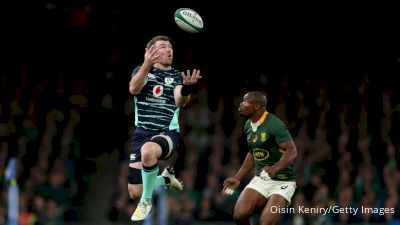
Ferocious, unrelenting and utterly captivating, the much-anticipated clash between world No. 1 Ireland and reigning world champion South Africa will go down as an all-time classic.
Squeaking out a narrow 19-16 win ensured Ireland will remain atop of the World Rankings for another week.
The stage was set early in the week, as the pressure was ratcheted up by the media in both countries labeling the clash a dress rehearsal for the two sides’ Rugby World Cup pool clash next season.
Billed as a clash of contrasting styles between the brutally effective Springboks physicality and the flowing Irish attack, this fixture proved that when the chips are down, there is little to choose between the two.
For Ireland, the ability to not only hold its own, but to at times get on top of the famed Springbok pack – and more crucially, their much lauded “bomb squad” bench – will be a significant relief for the Irish coaching team.
Equally for the Springboks, their defense, by and large, proved once again that it is right there with the best in the world.
As the All Blacks learned in the June test series, if given an inch, the Irish attack will take a mile. As such, the supersonic speed with which the Boks defense rushed the Irish ball carriers, while negating their ability to get the ball wide, was eye-catching.
Taking a bigger-picture view of this clash, it’s significance will not be lost on either side.
For Ireland, being ranked No. 1 in the world previously has been a hollow experience, one in which the team consistently is reminded of its failure to produce when it matters at the World Cup.
This time around, however, there is a different feel to the men in green, a 2-1 series win in New Zealand, backed up by a victory over the world champions, means this ranking feels truly deserved.
In 2018, while sitting atop of the Rugby World, there was a sense of fragility prior to the wheels falling off at a rapid rate, as England came to Dublin to give them a Six Nations drubbing, before going further and obliterating them 57-15 this time at Twickenham.
Now having beaten two of their primary World Cup foes in South Africa, and potential quarterfinal opponent New Zealand, Ireland will feel confident that is has the tools to beat either side when it counts. Admittedly, the gargantuan shadow that host France currently casts will worry Ireland as much as it does the Boks and All Blacks.
As head coach Andy Farrell noted in his post-match interview, this team feels truly tested in all areas.
“It was a hell of a test match, wasn't it?” Farrell said. “It had a bit of everything. We wanted to test ourselves in that regard, in terms of the physicality. It takes my breath away a little bit. Some of the lads played their first game of the season, and a lot of lads are down on minutes, and they put in a performance like that. We came out on the right side of it.”
Echoing his coach’s sentiments, Ireland center Garry Ringrose was pleased with the result but also made note that this side did not play to its utmost potential.
“To finish with a win, it wasn't pretty, and it was tight at the end, but we'll take it,” Ringrose said. “It's brilliant being back home. There are still a lot of things we could be better at, but they are such a good team and challenged us massively at times. To come away with a win against them, we are very happy with that.”
For the Boks, a narrow three-point loss in hostile territory, while not ideal, will not shake Jacques Nienaber’s side to core – a fact that Bok captain Siya Kolisi noted post-match.
“The game was everything that people watching wanted from a test match,” Kolisi said. “Ireland took their opportunities, and we didn’t, and that for me was the difference. But we are building as a team, and we will not make excuses about a long season. We came here knowing what we had to do, and Ireland were the better team today.”
Having come within a whisker of winning, they will be confident that a clash with Ireland is a 50/50 proposition.
If they expand their attack to include more width and crucially more ball-in-hand time for their lethal outside backs, the pressure to score exclusively through close-quarter dominance will be eased.
? Etzebeth ? Arendse to set up a thrilling end to this match#AutumnNationsSeries | #IREvRSA pic.twitter.com/LZJDXqEsQK
— Autumn Nations Series (@autumnnations) November 5, 2022
A prime example was their final try by Kurt-Lee Arendse, which ironically was completed by the towering second row Eben Etzebeth, who got his hands free in the wide channels to put Arendse over untouched.
One area that cannot go unrectified, however, is the lack of a recognized goal kicker in the squad. Internationally, a kicker needs to be close to, or exceeding, an 85% success rate, a fact the Boks management team will know only too well.
Cheslin Kolbe’s two missed conversions, combined with Damian Willemse missing a sitter, by international standard, cost the Boks. While Sexton missed two conversions for Ireland, the Boks misses kept them a step behind their hosts.
Handre Pollard, of course, cleans up this issue, but as was shown in Dublin, the kicking stocks behind him look rather bare.
Johan Goosen looks likely to make his way back into contention, while Mannie Libbok has been sensational for the Stormers in United Rugby Championship.
Success at the 2019 World Cup was built on the foundations that were laid by Pollard’s boot, which rewarded the Springbok packs dominance. Building scoreboard pressure is crucial for this Boks side, which simply is not built to play from behind.
One would suspect that both Nienaber and South Africa Director of Rugby Rassie Erasmus will be acutely aware of this issue and will rectify it swiftly.
Kicking aside, one area that is hard to quantify and, as such, is difficult to rectify from a simple tactical standpoint, was Ireland’s ability to win the crucial moments.
One such moment was the scrum penalty the hosts won immediately upon the introduction of the Boks “bomb squad.” This was cataclysmic in the overall picture of where many felt South Africa would pull ahead.
Ireland did not wilt under the pressure of the South African bench and proved that it, too, has the depth in its squad to go the distance. This will be a concern for the Boks, who have relied heavily on their bench to close out fixtures over the past five seasons.
Secondly, it is important to take into account Ireland’s ability to score in a variety of ways, whether it is through a well-executed set piece or via broken play, the Irish have the ability to hurt the opposition in a multitude of ways.
? A cracking second try for @IrishRugby
— Autumn Nations Series (@autumnnations) November 5, 2022
Space out wide for Mack Hansen to fly off his wing to score ?#AutumnNationsSeries | #IREvRSA pic.twitter.com/rRqTsyPSKq
Interestingly, this is in direct contrast to the 2018 Irish side that played, ironically, a Springbok style of physically dominant rugby, which when it mattered, they couldn’t impose on opposing sides that fronted up.
Of course, the Boks have the players to play this style and have shown they have little interest in deviating from the course.
Thus, the stage is set. This precursor to the main event went the way of Ireland. Despite this, there remains plenty of water to go under the bridge before the grand finale in France less than 12 months from now.
Written by Philip Bendon